Who are the Delegates
Understanding National Conventions.

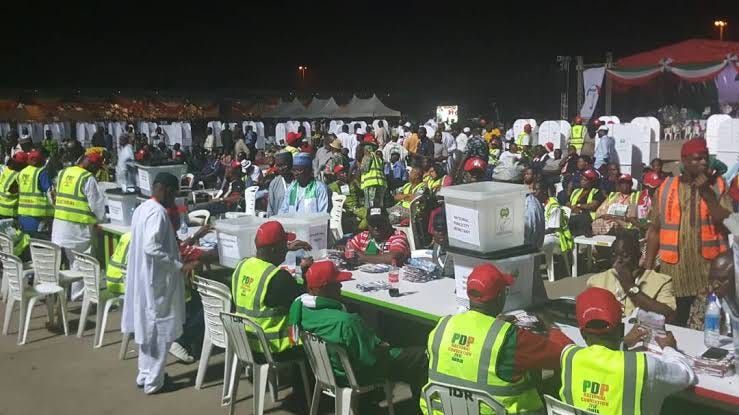
From observation, the electorate doesn’t appear to understand the fundamentals of partisan politics and how national conventions work; why they exist and how they are manoeuvred. Many have questioned the essence of Party Delegates, insisting that the masses are primary stakeholders and should therefore be a part of the decision making for parties. It is quite the odd argument especially considering the number of political parties in Nigeria that would produce candidates to represent them at the polls. How can the electorate decide for parties to which they don’t belong and select candidates to compete?
APC and PDP
There are two major political parties in Nigeria, the People’s Democratic Party(PDP) and the All Progressives Congress (APC). Both Parties have decided to nominate their Presidential candidates via the indirect primaries system. The indirect primaries system is highly controversial and really prone to abuse by party leaders in different states. This is why a lot of activists and political commentators have called for more transparency in place of the opaque system, and one of the problems that the new Electoral Act was expected to solve. The indirect system is enshrined in the constitution of the two major parties.
The alternative to the controversial indirect system is the direct primary election system that the APC tried to introduce. Unfortunately, it turned out to be even more controversial and susceptible to massive rigging. President Buhari was nominated via the direct primary system in 2019 - when the APC claimed that all party members voted in different states - and ended up having 3 million more votes in the primaries than he did in the general elections. The same thing happened in Anambra and in Lagos, to controversially boot out the then incumbent Governor Ambode.
The indirect primary system does not come without its own headache as controversy always surrounds the (s)election of party delegates to the national convention and the constitutions of both major parties allow for something called “statutory delegates”, the composition of which is vastly different for both parties. For the APC, the statutory delegates include former elected office holders alongside sitting ones.
APC Statutory Delegates
Members of the Board of Trustees
National Chairman and all members of the National Executive Committee
Serving and past Presidents and Vice Presidents of the Federal Republic of Nigeria who are members of the Party
Serving and past Governors and Deputy Governors of States of the Federal Republic of Nigeria who are members of the Party
Serving and past members of the National Assembly who are members of the Party, serving and past Speakers, Deputy Speakers and other principal officers of the State Houses of Assembly , and all serving members of the State Houses of Assembly who are members of the Party
Members of the States’ Working Committee (including that of the Federal Capital Territory, Abuja) of the Party
All Party Chairmen and Secretaries of the Local Government Areas/Area Councils of the country
All elected Local Government Council/Area Council Chairmen of the country who are members of the Party
In addition to these, three elected delegates (at least one of whom must be a woman) from each Local Government Area/Area Council of the country.
PDP Statutory Delegates
National Chairman of the Party
The President and Vice President of the Federal Republic of Nigeria
Members of the National Assembly, who are members of the Party
State Governors and Deputy Governors, who are members of the Party
All Gubernatorial candidates of the Party, who shall be automatic
Members of the State Houses of Assembly, who are members of the Party
Members of the Board of Trustees
Members of the Zonal Working Committee and State Party Chairmen and Secretaries, including those of the Federal Capital Territory, Abuja
State Women and Youth Leaders
Party Chairmen of the Local Government Areas
All elected Local Government Council Chairmen, who are members of the party
Former members of the National Working Committee who are still
members of the Party; and
Former Deputy Presidents of the Senate and former Deputy Speakers
of the House of Representatives who are still in the party.
In addition to these, the State elects one delegate from each Local Government to be national delegates at the convention.
The major difference between both parties in form of statutory delegates is the fact that the APC allows former serving members to vote at the national convention. This was done in order to attract big wigs from other parties, knowing that their vote at the convention will be a good negotiation tool. This is the reason for the increased defections to the APC by ex National Assembly members.
In a bid to reduce the influence of party leaders and money bags and with a focus on making conventions more democratic, the new Electoral Act made a new provision on who becomes a delegate to an indirect primary. Section 84(8) of the act expressly provides that: “A party that adopts the system of indirect primary for the choice of its candidate shall clearly outline in its constitution and rule the procedure for the democratic election of delegates to vote at the convention, congress or meeting”.
The best interpretation of ‘democratic election’ is that only delegates elected democratically can vote for a presidential aspirant to become its candidate in a convention . The parties are required to make rules that show how the delegates emerge from a democratic election. This new provision will end the use of statutory delegates, although the two major parties may have interpreted it differently and made it a controversial topic. Aspirants are still courting these statutory delegates all around the country as they are yet to hold elections for the elected delegates.
The elected delegates are chosen by the Local Government excos after Ward and LGA congresses to represent their Local Governments in addition to the Local Government Chairman of the party in the State. Usually, the Governors submit the names of their cronies in these Local Governments, usually to pacify the loyalists that lose out on LGA exco positions. In States without sitting Governors, it is thrown open as several leaders and money bags jostle for party machinery with different factions and lists making their way to Abuja.
The new electoral act was obviously passed to correct the previous situation where parties made the rules on internal party democracy on the go and party leaders used to decide what sort of delegates to use at different stages of the election, eventually introducing a system of ‘ad-hoc’ delegates where they quickly (s)elected new delegates from wards and LGAs in the absence of official excos. The new law gives INEC more power to override some of the decisions of party officials that violate the tenets of electoral democracy. It also obliges the party to conform to the fundamentals of electoral democracy, especially the protection of the right of choice of party members.
Courting Delegates
As primary elections approach, aspirants tour the country to talk to delegates about their plans for the party and the country. Usually when the election season starts, the national delegates are yet to be elected, because it is the last card in the hands of the Governors and they hold it very tight to their chests because these Governors, not matter how powerful they are cannot always control statutory delegates that were elected by the electorate themselves. Especially former office holders as in the case of the APC or BOT members and former EXCOS as in the case of the PDP.
The general assumption in the Public is that the delegates are only after money and bags of dollars will ultimately decide the winner, this school of thought ignores years of building a political base, having a network across the country where you have helped or sponsored leaders from Ward congresses all the way up. The politicking start from the state level, where aspirants get themselves involved one way or the other in LGA and state congresses especially in states where there is no Governor from their own party that can easily appropriate all the power.
Ultimately, all the candidates spend money, all the candidates attempt to dole money and accommodation out to delegates during the convention itself, but anyone that waits till the convention to get involved in the politicking will lose woefully regardless of the amount they are willing and ready to spend, because cash isn’t the ultimate decider for the delegates, they also want to be returned to office, they want their nominees to be appointed into key positions, they want to remain in control of their LGA/State structures. These, and several other things are the demands they make from the candidates and the national party structure. Only The strongest candidates politically can grant these wishes.
Most of the elected delegates have leaders that they listen to, during the horse trading, these leaders use their delegates to get promises from candidates, some candidates are willing to concede positions as high as VP to certain leaders during these negotiations. The leaders then in turn tell the delegates in their control the best candidate to vote for.
No party member, no matter how greedy to gain cash want to lose the next election, because even if greed is their only motivation, they stand to gain more when their party win the general election, this is why delegates and party leaders always gravitate towards the most popular candidate within the party regardless of funding. Politicians know that they must join a moving train at the very beginning in order to have a better negotiating position, this is why candidates also focus on the media, while they try to convince delegates across the country. Delegates will always vote for the candidate most likely to win the general elections, and their leaders will do the same.
Most of the horse trading happen at the venue of the convention itself, when candidates start negotiating to step down and ‘donate’ the delegates they have acquired to a stronger candidate in exchange for different promises, the primary proper starts two days before D-Day when delegates are settled in the host city, housed by the candidates that they’d most likely vote for. The candidates and their representatives then tour these hotels to make a final case for themselves and their candidates, making fresh promises and concessions.
Open Secret’s Take
Party primaries are tough; sometimes it’s harder to win the ticket of a major party than to win the general election itself, depending on the popularity of the party in that zone. It involves the rigorous work of convincing, buying and controlling delegates from different parts of the country. Long-term political networking is the best advantage anyone can have, regardless of their war chest. The possibility of winning the general election is also a big advantage. The delegate elections reflect the choice of the party at large because the national delegates are elected from each local government after Ward and LGA congresses. Delegates are the boots on the ground that will defend your votes in villages, towns and cities on Election Day when middle class voters return home to follow the election on TV and social media so, it is important for the party to choose a candidate for whom they are willing to go all the way.
Contrary to popular opinions on social media, it is beyond the war chest and bribery because delegates are accountable to the locals that sent them there and their leaders. National Assembly candidates cannot afford to sell their votes because of the ripple effect on their own election. Presidential elections and National Assembly elections are conducted on the same day and most voters vote the same party for both. If a Presidential candidate wins in a State, they will most likely sweep House of Reps and Senate seats too. This is the simple political logic that informs a lot of decisions at national conventions.
Excellent,in politics favours are traded like crypto
It was easy to understand with the way you illustrated it all. Thank you